
Why Media Organizations Need Domain-Specific AI Partners
Reading time:8 min
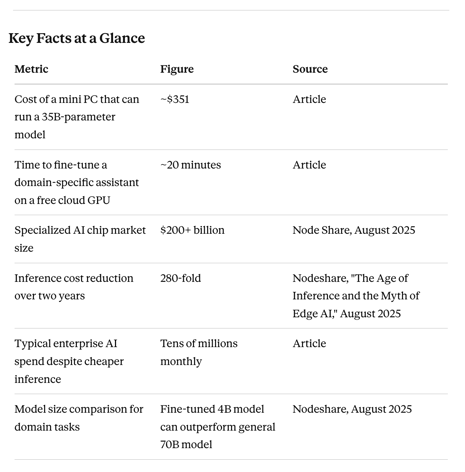
Edge AI hardware has gotten dramatically cheaper (a $351 mini PC can now run a 35-billion-parameter model), but cheaper inference has not translated into lower enterprise AI spend, because unmanaged usage outpaces cost reduction. Enterprise-grade workloads still lean on centralized data centers for three structural reasons: model size, energy demand, and the server-side orchestration that agentic AI requires. The real fix isn't choosing cloud versus edge; it's redesigning the process before choosing the infrastructure, so that compliance, sustainability, and cost are built in rather than retrofitted. That is the core of Support Partners' Catalyst methodology.
Why isn't cheaper edge hardware lowering enterprise AI costs?
Working at the edge is cheaper than it has ever been. A $351 mini PC can now run a 35-billion-parameter model, and a free cloud GPU can fine-tune a domain-specific assistant in about 20 minutes. Whether the motivation is security, governance, or logistics, though, edge AI still has to be economically feasible to run and provide value.
The gap between falling hardware cost and rising enterprise spend comes down to usage, not price. Inference costs have dropped 280-fold over two years according to Nodeshare's research, yet enterprise AI spend is still hitting tens of millions of dollars monthly at large organizations. Usage, largely unmanaged, has outpaced cost reduction. Every agentic workflow multiplies token consumption, so even a cheap model burns money when it runs the wrong process at scale.
Why does enterprise AI still rely on centralized data centers instead of edge devices?
Despite consumer hardware improvements, the majority of inference workloads remain centralized. Node Share's August 2025 research found that specialized, power-intensive AI chips represent a market segment worth <cite index="1-1">over $200 billion</cite>, underscoring how much infrastructure enterprise-grade inference still demands.
Three structural factors keep the cloud model dominant over pure edge deployment:
1. Model size: enterprise-grade models remain too large for local device memory
2. Energy consumption: high-performance inference requires wattage that edge devices cannot sustain
3. Agentic AI: autonomous, multi-step AI agents require continuous, server-side orchestration
What is "The Cost Per Shot," and why does it matter more than the GPU bill?
Running inference on-premises does reduce per-token cost. It does not reduce three other costs that rarely appear as a line item on a GPU invoice:
- The cost of AI producing the wrong output and requiring human remediation, what Support Partners calls "The Cost Per Shot"
- The cost of workflows that were already dysfunctional before AI and remain fragmented after it
- The iteration and rework cost that accumulates silently over time
This is the "new tools, old problems" trap: local AI deployed on a process that hasn't been redesigned is just a slower version of the same failure. Support Partners' starting point is always process design before infrastructure choice, helping clients see the true cost of their AI workflows rather than just the compute bill.
Should organizations choose cloud or local AI?
Neither, exclusively. The cloud-versus-local debate is a false binary. Leading enterprises are building three-tier hybrid architectures:
1. Cloud: for variable and experimental workloads
2. On premises: for consistent, high-volume inference
3. Edge: for latency-critical decisions
What none of those tiers answers on its own is what to run, on which tier, for which business outcome. That's a strategy question, not an infrastructure question.
How do GDPR and the EU AI Act affect the cloud-vs-edge decision?
Data residency requirements, AI transparency obligations, and sector-specific regulation in finance and healthcare mean "just run it locally" may be necessary but isn't sufficient for European operations. US organizations operating internationally face the same complexity in reverse. Support Partners works across both US and European regulatory contexts, and the infrastructure recommendation it makes is always downstream of the compliance and business design conversation, not upstream of it.
Does local AI reduce environmental impact?
Not automatically. Local AI reduces cloud spend, but a $351 mini-PCPC running inference continuously is still drawing power. At enterprise scale, distributed local inference creates a carbon accounting problem that's harder to measure than a single centralized cloud bill, and harder to ignore under EU sustainability reporting rules (CSRD) and growing US ESG disclosure pressure.
Nodeshare's research found that poor utilization of IT assets is the largest cause of energy waste in AI data centers, and the same principle applies to local fleets. Right-sizing the model to the workload, avoiding over-provisioning, and building in utilization monitoring aren't technical nice-to-haves; they need to account for governance requirements too.
There's a positive case as well: smaller, domain-specific models running locally can outperform larger general models on specific tasks. A fine-tuned 4-billion-parameter model can beat a 70-billion-parameter general model on a given task while being both cheaper and more sustainable. Organizations typically only reach that decision through systematic workload analysis, often after a significant amount of trial spend. Support Partners' Catalyst methodology includes workload mapping designed to identify where smaller specialist models can replace larger general ones from the outset, rather than after the fact.
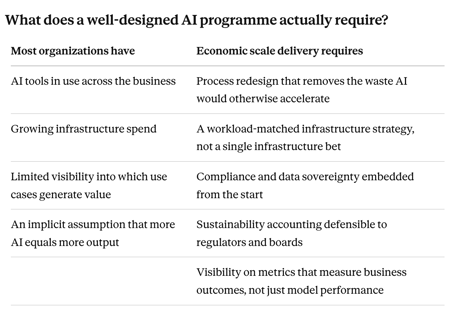
What does a well-designed AI programme actually require?
 |
|
None of these are infrastructure problems; they're operational layers. Addressing them requires a partner who understands the technology, the domain, and the operational context it sits inside.
How does Support Partners' Catalyst methodology help AI pay its way?
Catalyst is not a technology product selection service. It's a structured methodology for moving an organization from "we're kind of using AI" to "AI is driving significant benefits to the business." That means starting with the business outcome, mapping the workflows that affect it, and identifying where AI genuinely augments value versus where it adds cost and complexity. Whether an organization is operating at the edge or in a hybrid environment, the approach leverages existing technology platforms while keeping the desired business outcome as the driving priority.
Contact Support Partners to discuss Catalyst
FAQ
Why is enterprise AI spend still rising if inference costs have dropped 280-fold?
Because usage, not unit cost, drives total spend. Unmanaged agentic workflows multiply token consumption, so a cheap model still burns money when it runs the wrong process at scale.
Can a $351 mini PC really run a 35-billion-parameter model?
Yes. Advances in consumer hardware now allow devices in that price range to run models of that size locally, though enterprise-grade workloads still typically require centralized, specialized AI chips for scale and reliability.
What is "The Cost Per Shot"?
It's Support Partners' term for the cost incurred when AI produces the wrong output and requires human remediation, a cost that doesn't show up on a GPU invoice but still affects the total cost of an AI workflow.
Is cloud or local AI better for enterprises?
Neither exclusively. Leading enterprises use a three-tier hybrid model: cloud for variable and experimental workloads, on-premises for consistent high-volume inference, and edge for latency-critical decisions.
Does running AI locally reduce a company's carbon footprint?
Not automatically. Local inference still draws power continuously, and distributed local fleets can create a carbon accounting problem that's harder to measure than a centralized cloud bill.
What is the Support Partners Catalyst methodology?
Catalyst is a structured methodology that starts with a business outcome, maps the workflows affecting it, and identifies where AI adds genuine value versus where it adds cost, rather than starting from a technology or infrastructure choice.
Comments