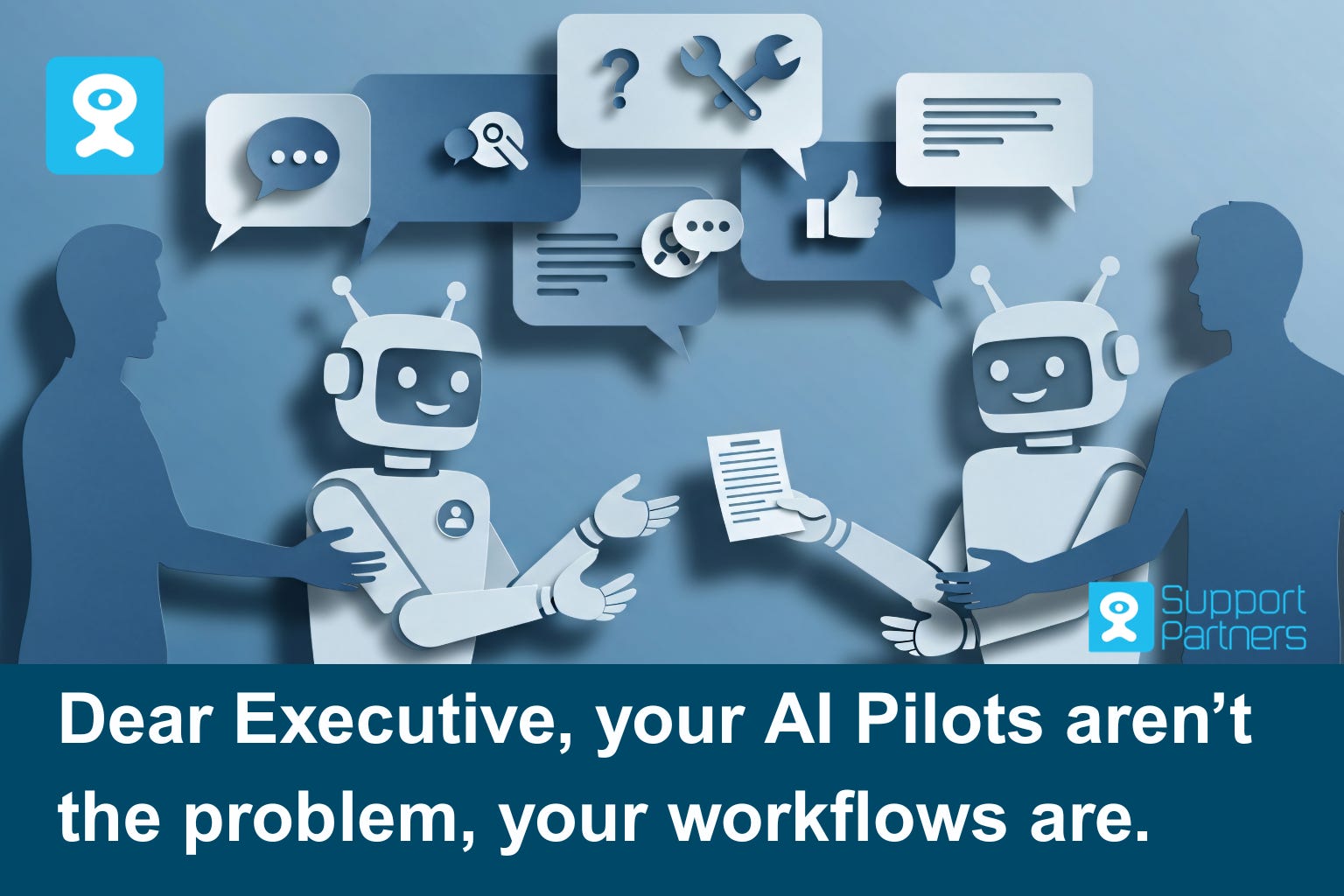
The enterprise AI landscape has reached an inflection point. Organizations have spent billions on proof-of-concept initiatives, but the real economic value only emerges when AI moves from experimentation to execution, working inside the daily workflows where your teams make business decisions.
Industry observers are noting this shift. Real ROI appears when AI stops being a pilot project and starts working inside the daily workflows where your teams make business decisions. The semantic layer bridges this gap, making AI practical and usable across your entire organization. And because AI doesn’t always produce identical results for identical inputs, you need workflow guardrails to ensure it delivers consistent, reliable business outcomes.
The challenge is straightforward. Your organization doesn’t need more AI pilots. You need AI that understands your production reality and delivers predictable results.
The Hidden Economics of Production AI
Most organizations focus on compute costs when planning AI infrastructure.
That’s a mistake.
Deloitte’s 2026 Tech Trends research reveals a striking pattern. While AI inference costs have dropped 280-fold over the last two years, enterprises are experiencing explosive growth in overall AI spending. Some organizations now face monthly AI bills in the tens of millions of dollars. The reason is simple: usage has grown faster than costs have fallen.
Here’s what traditional cost calculations miss. The real expense isn’t GPU pricing. It’s iteration waste, rework, and failures in production environments. When your AI systems don’t understand your business context and production requirements, they generate outputs requiring extensive human intervention to validate, correct, and finalize. Every AI interaction carries a hidden tax.
The most expensive AI infrastructure isn’t the most powerful. It’s the infrastructure that doesn’t understand your workflows well enough to deliver finished, production-ready outputs the first time.
What We Really Mean by “Semantic Layer”
Think of a semantic layer as a translator between your AI capabilities and your business operations.
Standard workflow orchestrators like Kubernetes understand infrastructure. They know about pods, containers, and resource allocation. But they have zero understanding of production requirements. They don’t know what a “finished deliverable” means in your organization. They can’t distinguish between a draft requiring human refinement and an output ready for production. They don’t understand deliverable specifications, creative intent, quality standards, or approval workflows.
A semantic layer changes this. It understands the meaning and context of your work. It learns from actual production results to recognize which AI outputs meet your standards and which require intervention. This isn’t metadata tagging or simple content classification. It’s genuine comprehension of your production requirements.
The difference? AI systems become informed participants in your workflows rather than blind task executors requiring constant supervision.
Why Current AI Falls Short on Production Work
The Remote Labor Index, a collaboration between the Center for AI Safety and Scale AI, measured how well frontier AI agents perform on real-world projects sourced from actual freelancing platforms. These weren’t simplified benchmarks. They were complete projects with defined requirements and human-quality deliverables as the gold standard.
The results are sobering. The best-performing AI agents achieved just 2.5% automation rates on economically valuable work. Despite rapid progress on research benchmarks, current AI systems struggle when confronted with the specific requirements, constraints, and quality standards that define real production work.
This isn’t a model capability problem. It’s a workflow understanding problem.
Measuring What Actually Matters
Organizations measuring AI value through infrastructure metrics miss the actual business impact. Tokens processed, API calls made, GPU utilization. None of these tell you what matters.
The relevant metric isn’t cost per token. It’s cost per finished deliverable that meets your production standards without requiring extensive human rework.
When AI systems gain semantic understanding, they learn from execution results and production feedback. They move from completing tasks to delivering outcomes. That shift transforms economics dramatically.
The Workflow Consistency Requirement
AI systems produce probabilistic outputs by nature. Embedding them directly into business-critical workflows requires more than powerful models. You need workflow controls that guarantee consistent business results regardless of output variations.
This isn’t about constraining AI capabilities. It’s about channelling them productively:
Risk reduction. Validate AI outputs against production requirements before they impact downstream processes or reach customers.
Productivity gains. Eliminate the iteration cycles that occur when AI outputs don’t meet specifications and require regeneration.
Competitive advantage. Deliver finished work faster through AI-augmented workflows rather than drafts requiring extensive human refinement.
Cost optimization. Measure true production economics rather than just infrastructure consumption.
The Architectural Advantage
Moving from pilots to production requires rethinking how AI integrates with enterprise operations. Deloitte’s research shows that only 1% of IT leaders report no major operating model changes underway. Everyone else is rebuilding.
Organizations succeeding with production AI share common characteristics. They prioritize semantic understanding of their specific workflows over generic AI capabilities. They measure outcomes, not outputs. They design workflow controls that account for probabilistic AI behavior.
Here’s what’s becoming clear from production deployments. Platforms built with semantic understanding from the ground up deliver fundamentally different economics than legacy systems with AI features added later. When semantic intelligence is architectural rather than supplemental, AI doesn’t just process your content. It understands your production context.
That’s the difference between AI that reduces costs and AI that increases them.
What This Means for Executives
The question isn’t whether to invest in AI. It’s whether your AI investments are building toward production-scale value or simply funding expensive experiments.
Organizations that will extract real economic value from AI are those mastering the semantic layer. They’re turning probabilistic capabilities into predictable business outcomes. They’re measuring cost per finished shot, not cost per token. They’re redesigning processes, not automating broken ones.
The shift from billions to trillions of tokens isn’t about scale. It’s about moving from experimentation to execution. The gateway to that shift is semantic understanding embedded in production workflows where business decisions actually happen.
Want to discuss how our AIR Platforms can help you extract real economic value from AI enabled production?
email: hello@support-partners.com