Thinking Before We Chat: AI, Sustainability, and the Power of Small Steps and Bold Action
The conversation around artificial intelligence and the environment is getting louder, more heated and rightly so. Behind every AI-generated summary, every chat agent response, every image conjured from a text prompt, there is a datacenter loudly drawing enormous amounts of energy and water. If you have already refrained from sending a query to an LLM with please and thank you, it potentially shows you an unfamiliar step to rewire your brain and treat your interaction as mere zeros and ones, rather than a pseudo conversation. However, the scale of energy and water usage is incredibly difficult to comprehend from behind a keyboard; which makes these small steps seem like minuscule mitigations: global data center electricity consumption reached approximately 415 terawatt-hours in 2024, representing around 1.5% of the world’s total electricity use, and it has been growing at a compound annual rate of 12% since 2017, more than four times faster than total global electricity consumption. Alledging that if datacenters were a country, they would already rank as the fifth largest energy consumer in the world, sitting between Japan and Russia.
This, even in context, is extremely worrisome. But it is also one in where public and community pushback is starting to gain momentum and increasing media attention. Citizen power is how responsible large datacenter providers and hyper-scalers are forced to look at the impact that the insatiable thirst for AI compute is having on both our natural and urban surroundings. Occasionally these datacenter developers are forced to abandon development plans in locations that would drive up electricity costs for residents, drain water and hum loudly as noise pollution, despite the number of jobs that inevitably will be created.
Are Infrastructure improvements enough? Demonstrable benefits may be the key to separate “good” from “bad” actors in the sector.
Data centers have long been controversial, with statistics currently pointing to a 70% rejection rate from Americans at large who are increasingly having to fight off data center developers using both legal and political means. Datacenters consume vast resources, place strain on local utilities, and their expansion has often outpaced communities’ ability to absorb the impact, both in urban as in natural areas. The sheer size described as tens of football pitches long. Water has become a serious flashpoint, especially in the light of climate warming and increasing drought. Cooling the servers that power AI requires enormous quantities of it, and in an era of increasing water stress across the globe, this is an urgent concern. Of course, water is not the only sticking point, but it is a vital resource, and access is undeniably a human right for all.
As a business in the age of AI, we all face an uncomfortable juxtaposition against our sustainability goals and sensitivities, which is why, as a Microsoft Partner, we are consistently invested in evaluating how Microsoft is tackling this huge environmental problem of supply and demand.
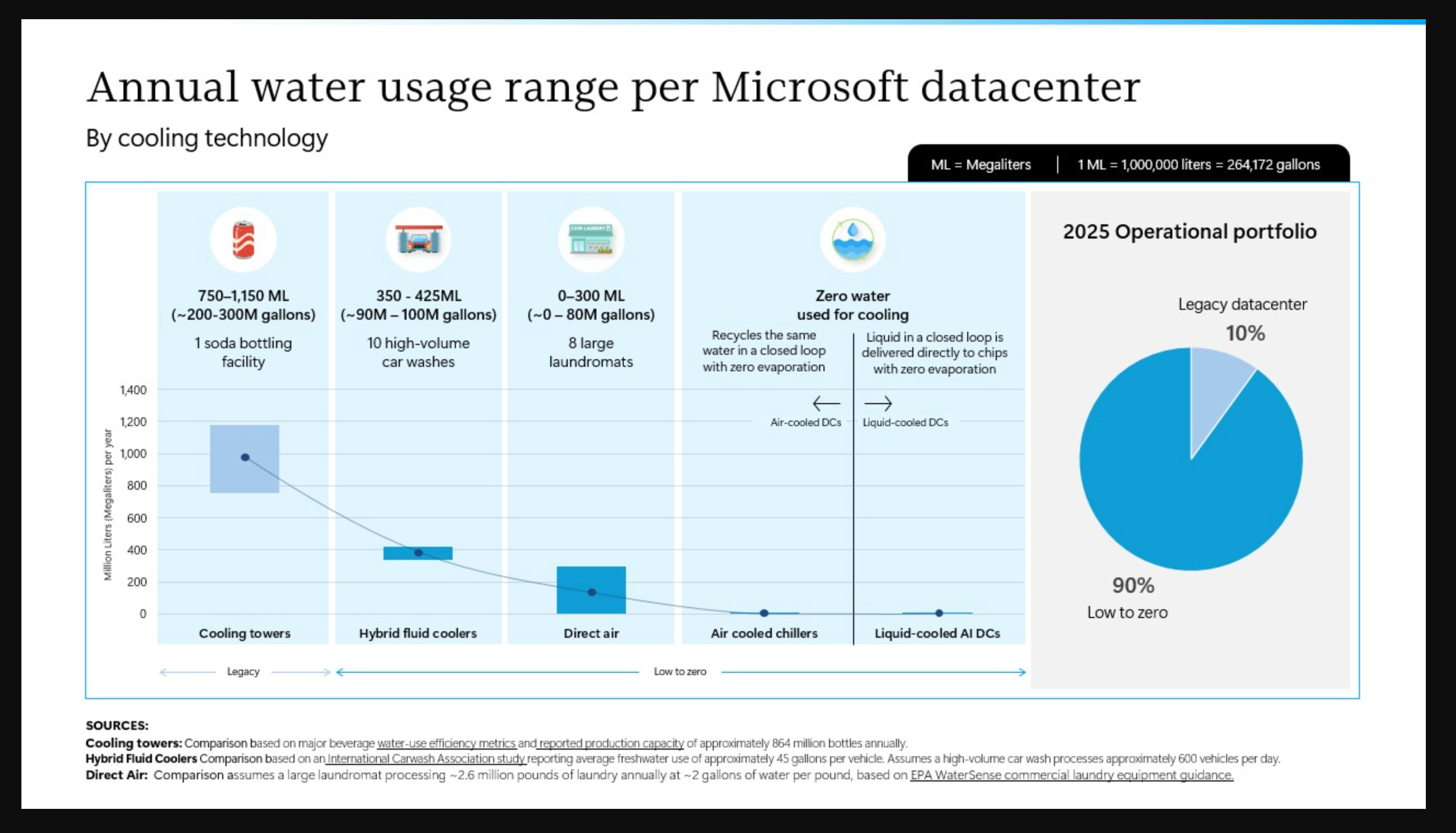
In the Jun 24, 2026 blog authored by Judy Priest, CVP and CTO of Cloud Operations & Innovation and Steve Solomon, VP Datacenter Engineering (https://blogs.microsoft.com/blog/2026/06/24/inside-microsofts-two-decade-push-to-cut-water-intensity-while-scaling-for-growth/) on its two-decade effort to address this challenge is worth paying attention to. Over the past twenty years, the company has worked to innovate and reduce its water consumption rate by 90% compared to levels when it opened its first datacenter facilities in the early 2000s, bringing its usage down to 0.27 litres per kilowatt-hour last year, which is roughly three times better than the industry average.
The methods behind this are interesting. Early facilities used high-efficiency economizing chillers operating at elevated temperatures. By 2008, Microsoft shifted to direct air cooling with evaporative assist, a design that uses outside air and only introduces water when temperatures exceed 29.4°C, cutting consumption by up to 90% compared to traditional systems. More recently, the company has moved towards chip-level cooling that recirculates water through the system and has been expanding its use of recycled and non-potable water. In three key operational hubs, Quincy in Washington, San Antonio in Texas, and Singapore, Microsoft uses 74%,79% and 99% recycled or non-potable water respectively.
To learn more about Microsoft Closed Loop DataCenters How does closed-loop cooling work at Microsoft Data Centers?
New projects in Phoenix, Arizona, which is located in a desert, and Mt. Pleasant, Wisconsin, will pilot zero-water evaporated designs in 2026, with these next-generation facilities set to come online by late 2027. With a Support Partners office based in a rapidly growing Phoenix, we understand the precious and precarious water resources that feed the desert to make it a liveable city.
Beyond its own operations, Microsoft has committed over $25 million to water and sewer upgrades near its Leesburg facility in Virginia, and since 2020 has directed more than $500 million toward more than 75 water and wastewater infrastructure initiatives worldwide. Its Datacenter Community Pledge commits the company to protecting local watersheds and funding any required system improvements in full, so that communities do not bear the cost of supporting its infrastructure.
Crucially, Microsoft reached an important milestone in FY25: replenishing more water than it withdrew across its global operations for the year, demonstrating that digital growth and sustainable water management can, in fact, advance together.
This is a meaningful proof of concept from their perspective. Scale does not have to mean unchecked harm, and keeping these organizations accountable is a vital part of sustainable progress.
The Broader Challenge: When Demand Outpaces Progress
Microsoft’s progress is real, but the wider picture remains complex. Global spending on AI-focused data center infrastructure reached an estimated $580 billion in 2025 alone, and demand is not slowing. AI energy demand is expected to roughly double by 2026, driven primarily by general-purpose AI systems such as large language models.
Outside of just the general human anti-datacenter and anti-AI feeling, this creates a fundamental tension: even the most efficient data centers nevertheless face a rising tide of demand. Efficiency gains per unit of computation can be, and often are, outpaced by growth in the volume of computation being performed. The industry term for this is the “rebound effect,” and it is one reason why infrastructure-level improvements alone cannot solve the sustainability challenge.
Which brings us to a question that receives far less attention than data center cooling because it centers on human behavior: how much AI are we using, and do we need to use that much? The cost of AI could certainly apply some brakes, but the uncontroversial fact is that AI is not going away; that pandora is most definitely out of the box.
The Human Responsibility Side of the Equation
Every query sent to an AI system consumes resources. A typical 100-query ChatGPT session translates to roughly 0.5 litres of water in cooling alone, and that is before accounting for energy. Multiply that by hundreds of millions of users making dozens of queries a day, and the aggregate impact becomes substantial.
This is not an argument against using AI. It is an argument for using it thoughtfully and insofar as we can today make a claim this short measure is a small cumulative step for sustainability.
That distinction matters, because the sustainability conversation in AI has so far been dominated by what the industry can do: better cooling, renewable energy contracts, more efficient chips. Very little attention has been paid to what individual organizations and users can do to regulate their own consumption. The paradox is evident, more machines doing more human work, or humans augmenting their basic tasks to AI. The balance is still not calibrating.
Education is certainly a key factor, with understanding and knowledge, younger generations will hopefully right the wrongs of the first adopters.
Support Partners, AIR Fusion, and a Human-Led Approach
Herein lies the conundrum for Support Partners, how do we implement an optimized level of AI usage, conscious of this huge energy expenditure? So where did we start? Not at the infrastructure level, but at the point of decision at which we intentionally design our AI-native products built from the ground up and by choosing which platform we want to support. We can direct our efforts into pulling back on AI where it doesn’t add value or where we intentionally want to keep that energy restricted to allow for human led input and creativity.
AIR Fusion is an AI-Native content intelligence platform that was built by Support Partners with sustainable thinking behind many of its features, such as being able to tag and classify content either manually or through AI assistance. The distinction matters: users choose how much AI involvement is appropriate for a given task, rather than defaulting to full automation as a matter of course. That design philosophy, human judgement in the lead, AI as a tool rather than a replacement, is not incidental. It reflects something deliberate about how Support Partners thinks about AI more broadly primarily because it is building AI-native solutions and not “bolted-on” AI.
Internally, Support Partners has developed an AI Policy that governs how AI and Agentic AI are used within the organization, including how token consumption is managed. Alongside this sits an AI Mandate centered explicitly on Human Skills and Human Led AI, the principle that AI should augment human capability, not erode it. These are not just ethical positions; they are practical ones. An organization that is deliberate about when and how it reaches for AI naturally can hone and direct how it is used and uses it more purposefully when it does.
Together, AIR Fusion and this internal framework represent a coherent answer to the demand-side sustainability question. Rather than treating AI consumption as a given and attempting to offset it elsewhere, Support Partners builds the conditions for conscious use directly into its product and its culture. Supporting a hyper-scaler that commits investment and innovation to solving the most pressing issues regarding datacenters, is also a fundamental and intentional choice where governance and legislations still lag behind the pace of development.
Putting It Together: A Two-Sided Sustainability Equation
What Microsoft’s water stewardship story and Support Partners’ approach share is a recognition that progress requires action at multiple levels simultaneously. The infrastructure giants need to keep innovating, zero-water cooling, renewable energy, community investment are all essential. But they cannot do it alone, and the trajectory of demand means efficiency gains at the supply side will always be playing catch-up.
A vital missing piece is a culture of conscious consumption, organizations and individuals who ask, before reaching for an AI tool: do I actually need this? And if I do, am I using it in the most considered way? Am I supporting an organization that takes water-stewardship seriously and is investing to preserve valuable resources?
AIR Fusion gives organizations a platform where that question is built into the workflow, where the choice between human tagging and AI assistance is explicit, not assumed. Paired with an internal culture guided by an AI Mandate that keeps human skills and human judgement at the center, Support Partners demonstrates that sustainability in AI is as much about culture and design as it is about cooling systems.
Of course, there is more to data centers than just water cooling. Community consultations and thoughtful placements of these data centers where the environmental impact is fully considered and consulted should be an integral part of regulations. The debate and controversy of course continue as this new era of AI evolves at mach speed, but at each stage of evolution, continuous evaluations become an integral part of how companies and users can help shape what happens next to help protect our natural resources and our environment.